
A website rebuild should include the route plan, message hierarchy, page copy, responsive design system, page implementation, lead capture, search foundations, launch checks, source files, and written handoff. The scope should also name the inputs, review points, fixed constraints, and every item that remains open.
The scope is the working definition of the rebuild. If it does not tell you what gets made, what you have to provide, how the work gets approved, and what you own at the end, it is not a scope. It is a quote with adjectives.
Use the sections below as the checklist.
Business inputs and fixed constraints
Start with the audience and what the site is for. List the offers, the facts, and the buyer questions the site has to cover. Then pull together the existing identity, copy, images, source files, and technical requirements.
Write down anything that cannot change: a required platform, an existing domain structure, an approved identity, a publishing constraint, a fixed integration. Get the rights clear on every supplied image, clip, and block of copy before production, because sorting rights after launch is miserable and expensive.
Missing pieces go in the scope too. Naming them up front makes responsibility visible and keeps review tied to an agreed list instead of a moving one.
Route plan and message hierarchy
The route plan names every page in the rebuild and how the pages relate. The message hierarchy decides what a buyer understands first, which facts back the offer, and where the detailed questions get answered.
Every page gets one job. A useful page brief covers:
- The audience and search intent
- The exact question the page answers
- The supported facts it can state
- The proof or example it can show
- The internal links it needs
- The written action it should lead to
Keyframe0's website capability includes information architecture, message hierarchy, structure, copy, pages, and lead capture.
Complete page copy
Copy means all of it: headings, body sections, proof captions, form labels, validation messages, metadata, and the written next action. Lorem ipsum hides structural problems until the worst possible moment, so review the design with the real message in it.
Put the important answers in visible text, in complete sentences that stand on their own. Keep the factual claims identical across capability pages, proof, metadata, structured data, and intake. A site that contradicts itself is a site nobody can trust, including the machines reading it.
The scope states who approves the copy and how revisions get recorded.
Responsive design and implementation
The page system defines typography, spacing, color, media treatment, navigation, buttons, forms, and the reusable content patterns, plus how all of it behaves on a phone versus a desktop.
Review complete pages with real content. Throw the long headings at it, the dense sections, the tall images, the wide video, the error messages, the keyboard focus. A component list is nice. A buyer experiences the assembled page.
Implementation covers every approved route and the connected lead path. If identity, campaign graphics, key art, or art-directed stills are part of the deal, the scope names them directly instead of hiding them in "design assets."
Lead capture
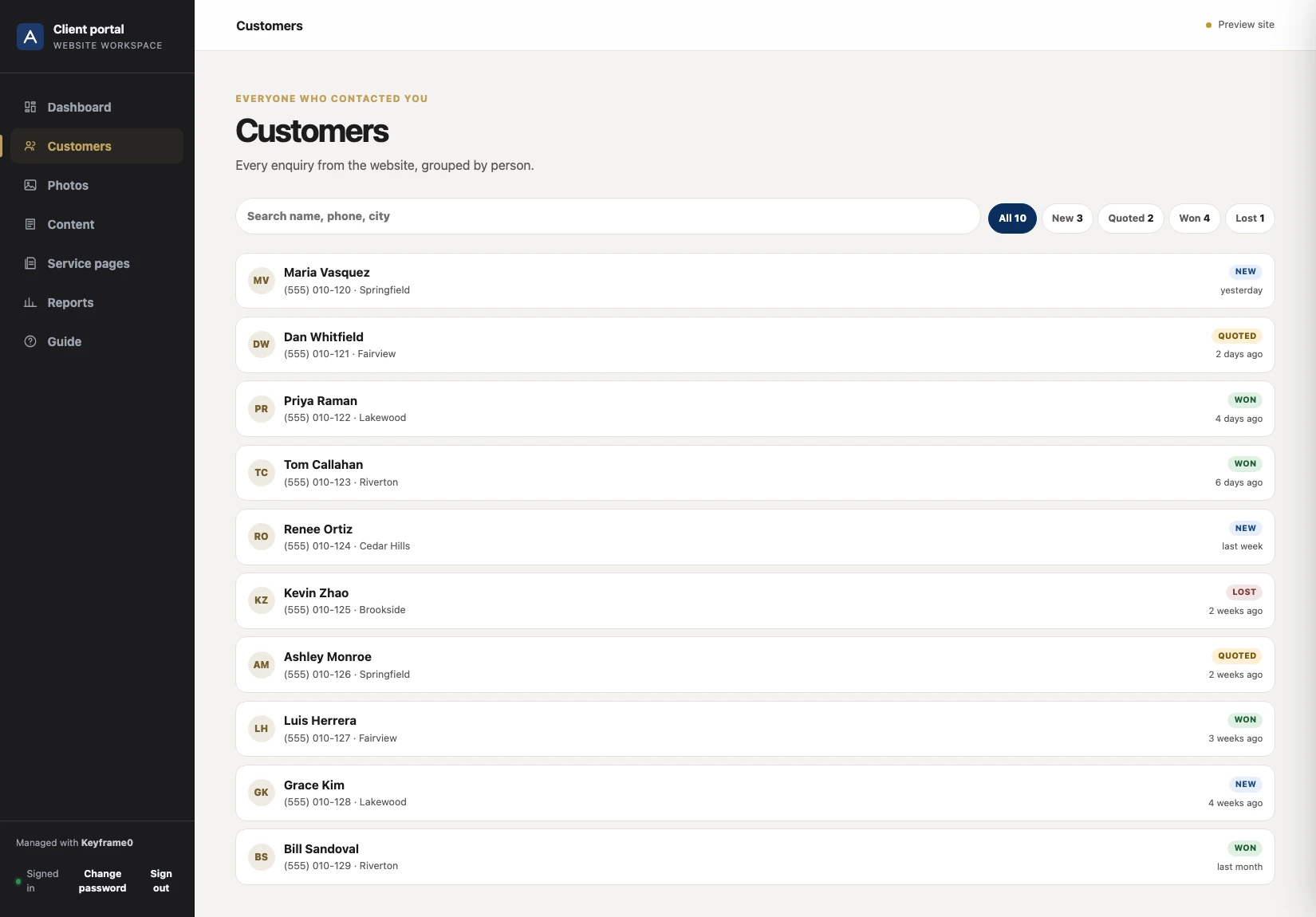
Lead capture connects the site to one clear written intake. Define the fields, the required and optional states, validation, submission handling, the success state, the privacy link, and the failure state. Yes, the failure state. Forms fail.
The page leading into the form should tell the buyer what to send: audience, objective, current material, required deliverables, technical constraints, source rights, and a fixed date if one exists.
Test the complete submission path before launch, not after. Keyframe0's conversion path is Work with us.
Search and AI-answer foundations
The rebuild should give engines one consistent read on the business: distinct page titles and descriptions, canonical page relationships, structured data that matches the visible content, a current sitemap, discovery files, direct answers, and internal links.
Search and AI-answer systems do best with clear page ownership and consistent facts. Write the direct answer for a person first. Keep structured data describing what is actually on the page, because markup that oversells the page is a liability, not an optimization.
The SEO and AI-search capability covers a supported fact map, a question-and-answer map, visible answers, structured data, discovery files, metadata, and internal links.
Ranking, traffic, and virality guarantees stay outside the work. Nobody honest sells those.
Launch checks
Launch checks cover the approved routes, navigation, internal links, forms, metadata, structured data, sitemap, media, responsive behavior, and basic accessibility. When paths change, the redirects get recorded, or the old links die quietly and take their search history with them.
The scope names who can approve launch and which issues have to be closed before publishing. Any accepted open item moves into the handoff with a clear status instead of evaporating.
Written handoff
The handoff includes the approved site, source files, implementation notes, launch checks, and the agreed visual and copy rules. It lists the connected systems, what they need to keep running, and any continuing work included in the project.
A practical handoff answers these questions:
- Which files and repositories transfer?
- Which pages and features are complete?
- Which credentials or system access must change hands?
- Which source rights apply?
- Which tasks remain open?
- Which ongoing work belongs to the current scope?
Keyframe0 hands over source files and plain implementation notes. Your next hire could pick the site up tomorrow. Ongoing site operation is included when the written project scope names it.
Put the rebuild in one written scope
Compare the proposed scope with the full capability list. Website, search, creative, and motion can connect inside one release, and each included lane needs its own deliverables and its own boundary.
Work with us to send the audience, required pages, existing material, technical requirements, and fixed constraints in writing.