
Give Google, ChatGPT, and Gemini a clear, consistent, supported source for the questions buyers ask. Publish direct answers in visible page copy, connect each answer to the right page, and align the metadata, structured data, sitemap, discovery files, and internal links with those same facts.
AI-search visibility starts with information the business can support. Engines read the pages and machine-readable signals they can reach, then use that material when it fits a question. The clearer the source, the better their read on what your business actually says about itself.
This work gives you a stronger source. It cannot control whether an engine picks it. Hold onto that distinction, because a lot of people selling AI-search services would rather you didn't.
Build a supported fact map
List the facts the site needs to state. Organize them by business, offer, audience, process, deliverable, boundary, and next action. Give every fact a source inside the business.
A fact map stops pages drifting apart, and it makes review concrete: a reviewer approves a sentence, sees its basis, and sees every page that depends on it.
Unresolved claims stay off the site until the business can support them. Copied industry claims that describe a category without proving anything about your business go in the bin. "We deliver world-class results" tells an engine nothing and a buyer less.
Keyframe0's SEO and AI-search work begins with a supported fact map and a question-and-answer map.
Map buyer questions to pages
Write down the exact questions buyers ask before they choose a provider, in their words, and assign each one to a primary page. A capability question lives on the capability page. A working-method question lives on the method page. A question about a finished piece lives with the work record.
The primary page gives the complete answer. Related pages link to it with descriptive language. That is the whole relationship between broad topics and detailed answers, and it is enough.
A useful question map records:
- The buyer question in the buyer's words
- The intent behind the question
- The page responsible for the answer
- The supported facts required
- Related pages that should link to it
- The next written action

Write direct answers in visible copy
Put a concise answer near the top of the responsible page, in complete sentences, with the subject named inside the answer so the passage survives being lifted off the page.
Then give the useful detail: the inputs, the process, the deliverables, and the boundary. A buyer who arrives via the quoted passage should be able to act on the full page.
Skip claims that lean on missing evidence. Skip borrowed statistics and vague authority language. If a statement changes with the scope, say which input controls it.
The direct answer and the detailed page have to agree, and repeated copy drifts when it gets edited separately over time. Keep a record of where each approved fact appears.
Give every important page a clear job
Page structure tells people and engines where an answer belongs. Each important offer gets a stable page with a distinct title, heading, description, and body.
The website capability covers route planning, page structure, copy, responsive implementation, and lead capture. That page system is the surface the search answers live on.
Use internal links to connect related questions. Broad capability page links to detailed guide. Guide links to the relevant capability and the written intake. Link text names the destination's subject.
Align the machine-readable layer
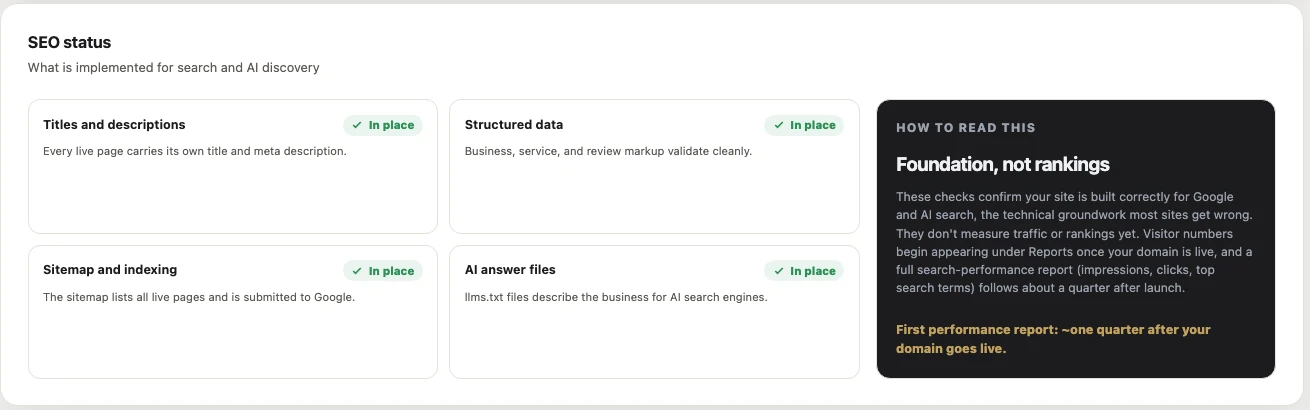
Metadata and structured data describe the visible page accurately. The sitemap includes the canonical pages that matter. Discovery files reflect the current site. Internal links match the page relationships in the content plan.
Search and AI-answer systems use these signals as part of understanding a site. Keep the implementation plain and consistent:
- Give each page a distinct title and description.
- Use one canonical address for each page.
- Add structured data that matches visible content.
- Keep the sitemap current.
- Maintain the discovery files included in the build.
- Check internal links after every route change.
Write each implementation item down so the business can see what exists and revise it when the facts change.
Check consistency before publishing
Compare the visible answer, title, description, structured data, and related links for every priority page. They state the same business facts or they get fixed. Read the answer outside the page context and kill the ambiguous references.
Check names, service descriptions, boundaries, and next actions across the whole site. A contradiction between two of your own pages hands an engine two sources and lets it choose.
Repeat the check when the offer, site structure, or approved facts change. Ongoing management belongs in the project only when the written scope includes it.
Set an honest expectation
This work creates a consistent, supported source for engines to use. It improves page clarity, answer coverage, and technical alignment. Ranking, traffic, and inclusion in an AI answer stay outside a studio's control. Nobody honest sells those.
Keyframe0 offers a free written site review through Work with us. Send the web address and use the written intake to request it.