
SEO and AI-search optimization should run as one coordinated project. Both depend on crawlable pages, supported facts, clear page purposes, useful internal links, accurate metadata, and structured data that matches visible content. AI-search work adds direct, self-contained answers and checks how those facts appear when an answer engine responds to buyer questions.
Search results and generated answers present information differently, but they eat from the same plate. A business needs pages that engines can reach, understand, connect, and trust as an accurate statement from the business. Build that once and both surfaces benefit.
Running them as separate projects is how one team ends up changing titles and routes while another writes answer copy against a site structure that no longer exists.
Start with the shared fact foundation
Both workstreams need an approved description of the business: the offers, the audiences, the process, the deliverables, and the boundaries. Write these facts down before anyone picks keywords, headings, schema types, or answer-file entries.
Give every fact a source inside the business. Flag the uncertain claims for review. Unsupported claims stay off the public site and out of every machine-readable field. No exceptions for the ones that sound good.
A fact map records one approved sentence for each important claim and every page that uses it. That is what stops the service page, home page, guide, and structured-data block from describing the same offer four different ways.
Build a page system around search intent and buyer questions
SEO planning figures out what a searcher needs and which page should meet that need. AI-search planning writes the buyer's question out in full and makes the page answer it in a passage that stands alone.
Both views belong in one route plan. Each primary page needs:
- A defined audience and purpose
- A primary search intent
- The buyer questions it owns
- The supported facts required for the answer
- Related pages and internal links
- One canonical URL
- A written next action
The website capability covers the route plan, message hierarchy, responsive pages, copy, and lead path that carry this system.
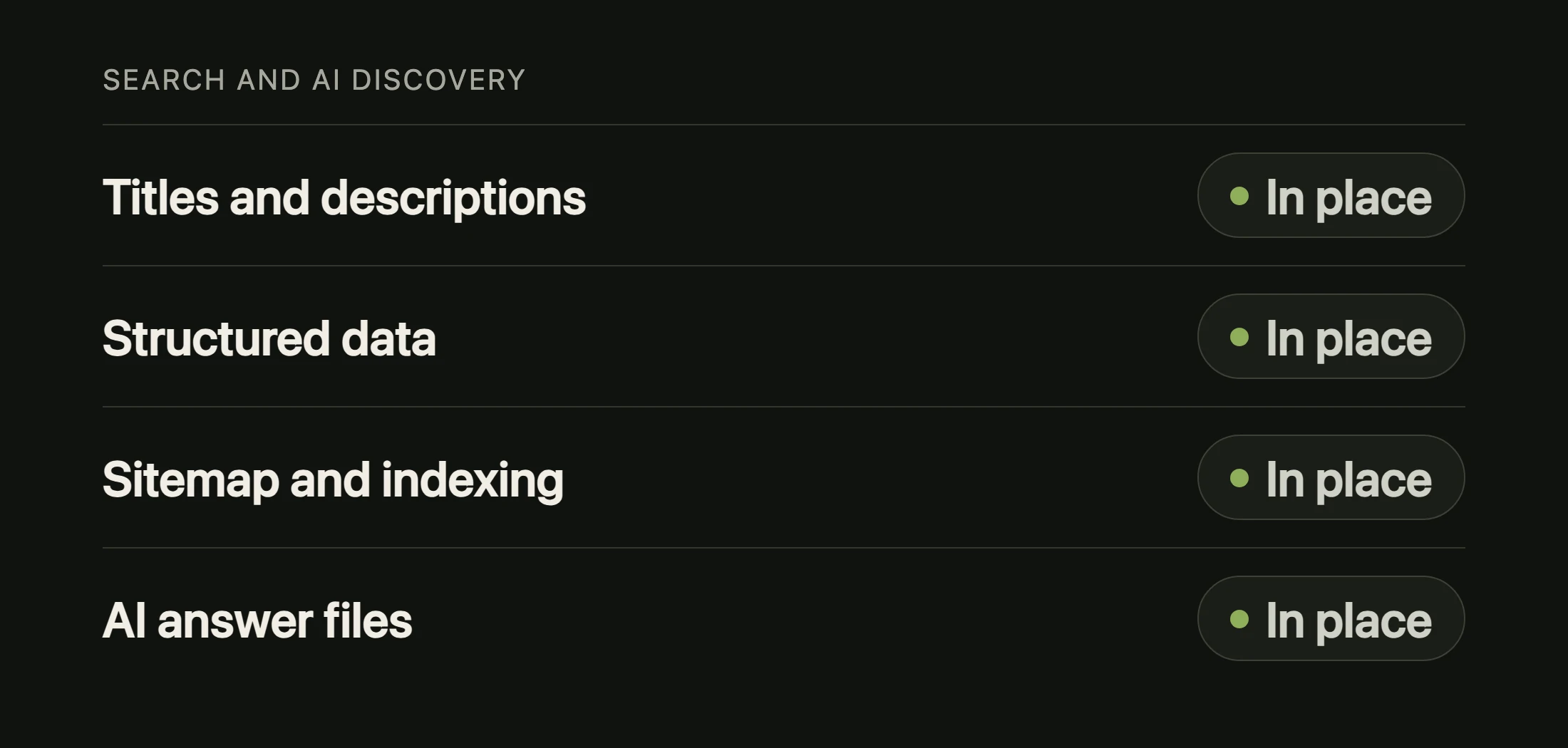
Use titles and descriptions to state the page's job
The title identifies the subject. The description explains the answer or the value the page delivers. The H1 and opening copy keep that promise. When those four agree, a search engine can classify the page, an answer system gets a concise statement of its purpose, and a buyer can decide whether the page fits the question.
Give every public page distinct metadata. Point duplicates and variations at the approved canonical page. When a route changes, update the internal links, the sitemap, and the machine-readable summaries in the same pass, not whenever someone remembers.
Publish direct answers with supporting detail
SEO copy needs enough substance to satisfy the searcher. AI-search copy wants a direct answer near the top, in complete sentences, with a named subject and a clear boundary.
The body backs the answer up: inputs, process, deliverables, limits, and the relevant evidence. Headings describe the question each section resolves. The essential information lives in visible, server-rendered HTML.
An extractable answer has to stay accurate outside its original layout. Pronouns with no referent, vague callbacks, slogans, and unsupported superlatives all break that, which is one more reason to cut them.
Add structured data after the visible copy is settled
Structured data labels the entities, page types, and relationships already on the page. Use the schema type that fits the real page and complete only the fields the business can support.
Compare names, descriptions, dates, images, offers, and canonical addresses with the visible page. Strip fabricated reviews, ratings, awards, results, and business details. Validate the markup before launch and again after major content changes.
The structured layer describes the page. It does not get to carry a separate, shinier version of the business story.
Keep discovery files and internal links current
The sitemap names the canonical pages you want crawlers to find. Crawler access rules state which automated readers may reach which paths. Optional answer files summarize the site and point to the detailed evidence pages.
Internal links establish the human-readable relationships among those pages. Use descriptive link text, make every priority page reachable, and remove links to retired routes.
Review these together:
- Canonical page list
- Sitemap entries
- Crawler access rules
- Internal links
- Structured-data URLs
- Answer-file links and summaries
- Redirects and retired routes
There is no dedicated AI file that flips a placement switch. The ordinary page and search foundation is still the job.
Add AI-answer checks to the search review
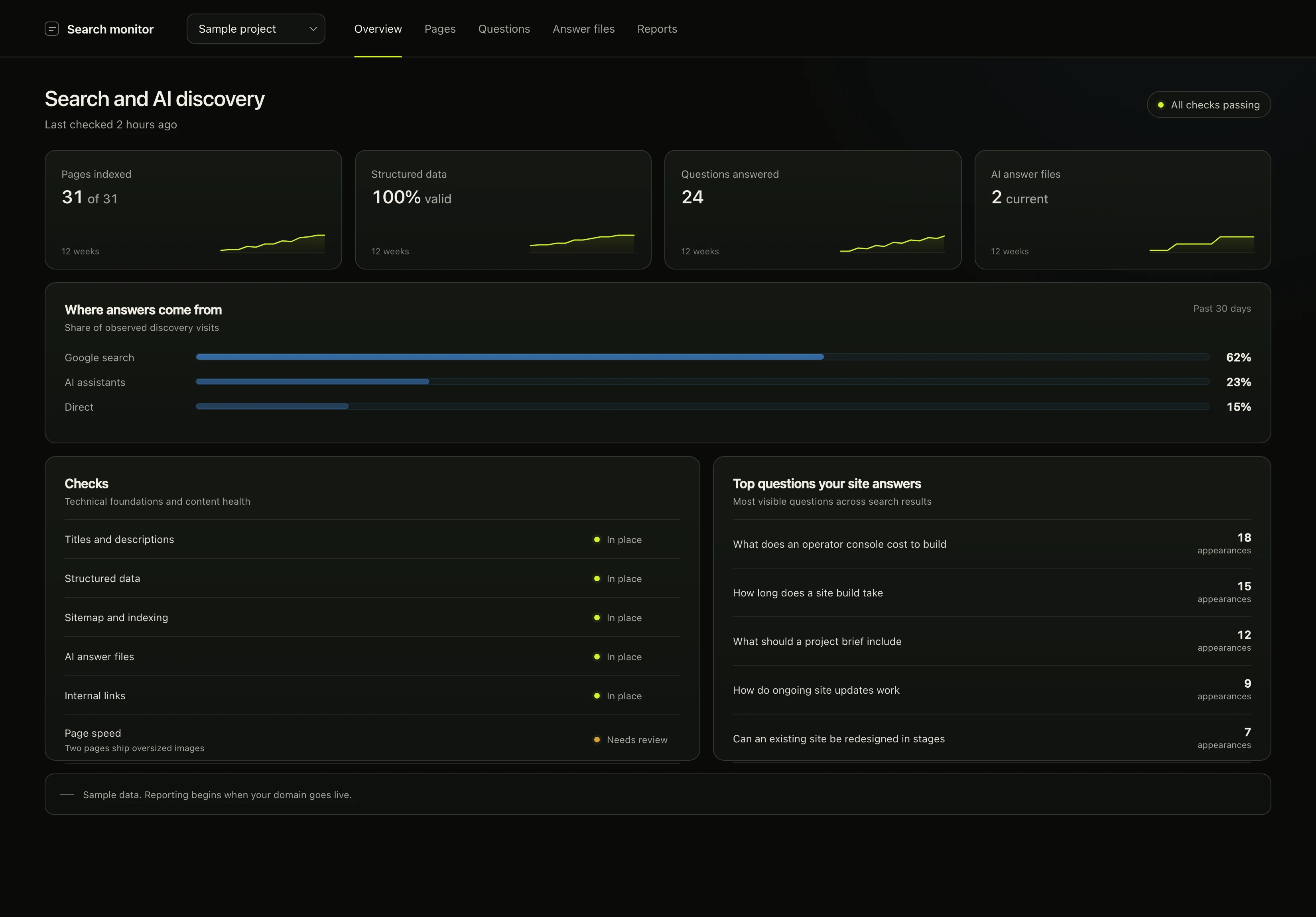
Traditional search checks cover reachability, indexing eligibility, titles, descriptions, canonical URLs, internal links, and search-result presentation. AI-answer checks reuse the same buyer questions recorded in the plan.
Ask the selected engines those questions and record the answer, the source links, the correct facts, the missing facts, and the contradictions. Trace each problem back to the owned page responsible for it. A missing answer usually means a missing passage. A wrong fact usually means stale or conflicting pages. An absent source usually means weak discovery or a page that never states the answer directly.
Responses change across engines and over time. Record the exact prompt and the review date so later checks compare like with like instead of vibes with vibes.
Keep one written implementation record
The record names the fact map, question map, page owner, title, description, canonical URL, visible answer, schema type, internal links, sitemap status, crawler access decision, answer-file entry, validation result, and review date for every priority page.
Use it during launch checks and every future revision. It shows what the site states, where it states it, and which machine-readable fields depend on the same approved facts.
Keyframe0's SEO and AI-search work combines these layers in one written implementation. Search placement, traffic, and inclusion in generated answers stay outside the studio's control. Nobody honest sells those.
For a free written review of the shared search foundation, send the site through Work with us.